
Optimising Conveyor Design Using Lagging Select™ Engineering Tool
Better Lagging Selection Starts with Better Engineering Training Is your engineering team equipped to optimise conveyor design for maximum reliability and cost efficiency? Elastotec’s “Optimising Conveyor Design Using Lagging Select™ training course empowers engineers to: ✅ Design smarter – Understand the critical interaction between pulley lagging and conveyor belts to prevent common failures ✅ Improve safety […]
Elastotec: Reducing Downtime and Increasing Productivity in Mining
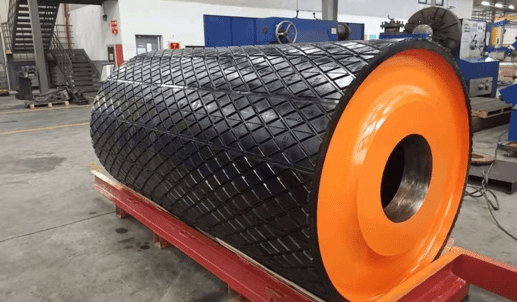
The main challenges of pulleys in contact with the carry side of the belt In conveyor systems, pulleys play a critical role in ensuring smooth operation, proper belt tracking, and effective material transportation. Among these, pulleys that come into contact with the carry side of the belt—often referred to as the “dirty side”—face unique and […]
Elastotec Lagging – Hot Vulcanised Ceramic Lagging

A large bauxite mine in Australia, running an overland conveyor with an ST3600 belt, 1050mm wide, has successfully introduced Elastotec Hot Vulcanised Ceramic Pulley Lagging to one of its sites.
Pulley Lagging and Belt Interaction for Power Transmission and Service Life

Conveyor drives and drive pulleys are a key part of the conveyor system, providing the power transmission required to move material. Engineers rely on guidelines from the Conveyor Equipment Manufacturers Association (CEMA) to design these drive systems effectively, employing mathematical techniques like Euler’s equation. However, while this approach focuses on preventing loss of traction, it overlooks potential wear and tear on critical components like the belt and pulley lagging. This paper aims to describe this issue, highlighting the need for a balanced approach that considers both loss of traction and localized slip which can result in wear and damage.
Conveyor Belt Bottom Cover Failure From Idlers and Pulleys

Excessive wear on the belt bottom cover resulting from improper idler arrangement and ceramic pulley lagging can lead to early belt failure and unplanned downtime. This paper discusses several failure modes and related field examples.
Theoretical Model to Evaluate Belt Wear Effects on Lagging Stress

Overland Conveyor Company was contracted by Elastotec Pty Ltd to develop a theoretical model to study the effects of conveyor belt cover wear on pulley lagging as a part of their Research and Development studies.
Elastotec at ICBMH 2023: Pulley Lagging Optimisation

Elastotec is thrilled to announce our recent participation in the 14th International Conference on Bulk Material Storage…
Pulley Lagging Selection and Performance Optimisation

Abstract : In belt conveying, pulley lagging is the source of necessary friction for power transfer.
Hot vulcanising vs cold bonding for pulley lagging application – what are the differences?

Cold bonded lagging has been used for more than fifty years largely, as a result of its ease and convenience of application.
T&T Perú 2023

Thank you to the Peruvian mining sector. Thank you for the space to discuss your challenges. Thank you for the opportunity to redefine conveyor reliability together. So much to work together on. So much to learn together.
