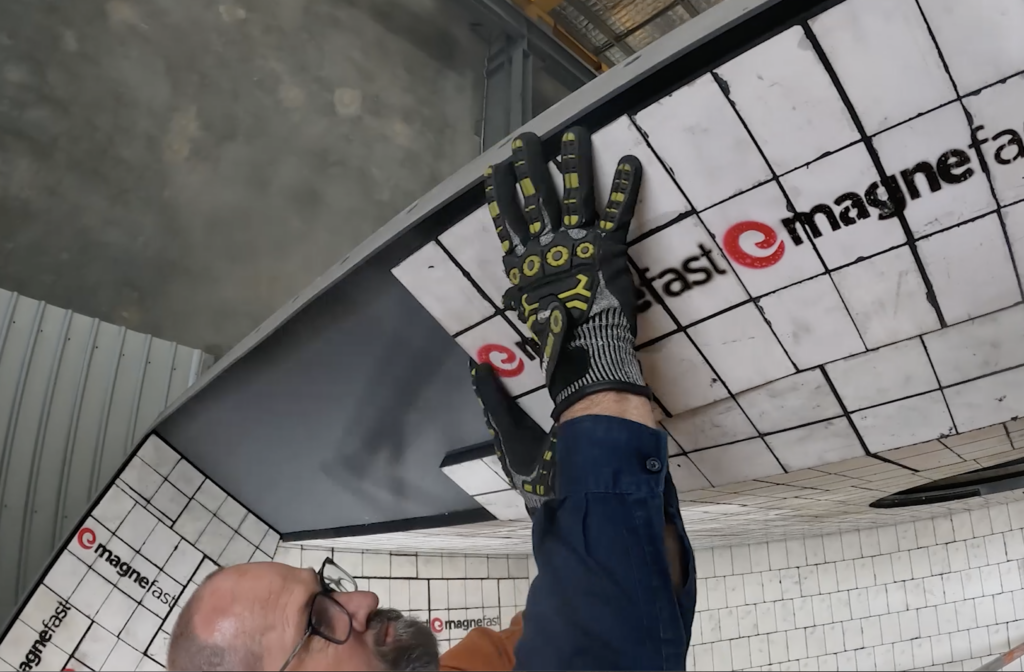
When pulley lagging on carry-side conveyor pulleys begins failing sooner than expected, the first assumption is often that the lagging has reached the end of its life—or that a different lagging product is needed.
In many cases, neither is true.
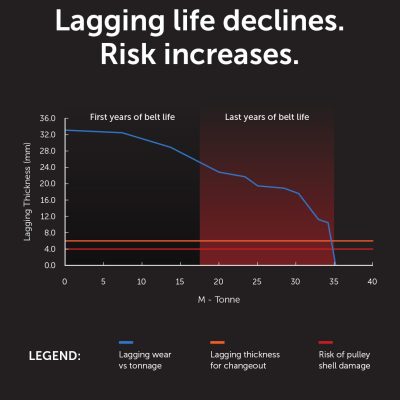
Across mining operations, Elastotec has identified a consistent pattern on pulleys in contact with the carry side of the belt, particularly high-tension bend pulleys. The first lagging installation performs well, but each subsequent replacement lasts a little less: 18 months. 12 months. 8 months. 6 months. 5 months
This isn’t random failure. It’s the result of changing belt conditions that fundamentally alter how loads are transferred through the pulley.
Understanding these changes is the key to extending lagging life, improving conveyor reliability and reducing maintenance costs.

It Starts With Belt Wear – Not Lagging Wear
When a conveyor belt is new, the system operates within predictable design limits.
The belt top cover is uniform across its width, steel cords remain aligned and tension is distributed evenly across the pulley face. Under these conditions, pulley lagging performs consistently and delivers predictable service life.
Over time, however, the belt top cover begins to wear, typically more aggressively through the centre of the belt. While this appears to be normal wear, it creates a much more significant structural change beneath the surface.
Belt Cord Displacement Changes Everything
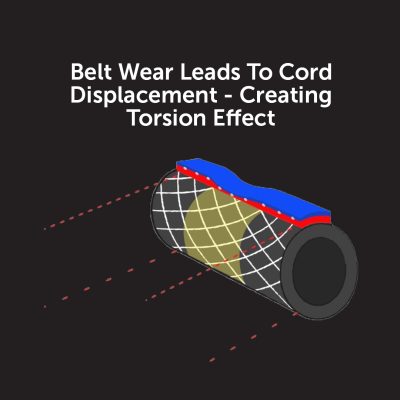
As centre belt wear increases, the geometry of the belt changes as it wraps around a carry-side bend pulleys in contact with the top belt cover.
The outer steel cords are forced to travel a greater distance than the centre cords, creating torsional forces and localised shear stresses that were never present when the belt was new.
These changing load conditions are transferred directly into the lagging system.
The lagging hasn’t changed. The belt has.
Why Lagging Service Life Declines
Once belt geometry changes, the lagging is no longer operating under the conditions it was originally selected for.
Across mining operations, this commonly appears as:
- Excessive central wear bands on bend pulleys
- Ceramic tiles tearing from the rubber
- Delamination between lagging plies
- Shortened lagging replacement intervals
- Increased maintenance frequency
Simply replacing the lagging does not remove the underlying cause.
The same lagging specification is now being subjected to higher stresses than before, meaning each replacement is likely to have a shorter service life.
Optimising Pulley Lagging Starts with Understanding Belt Wear
One of the most common questions maintenance teams ask is:
“What lagging will actually last?”
The answer isn’t always a different lagging product.
As belt wear progresses, the loading conditions on carry-side pulleys change. Belt cord displacement introduces higher torsional forces and localised shear stresses, meaning the original pulley lagging specification may no longer be operating within its intended design limits.
Replacing the lagging alone treats the symptom—not the cause.
A more effective approach is recognising when changing belt conditions require a different lagging strategy. By understanding the relationship between belt wear, belt cord displacement, pulley loading, and lagging performance, maintenance teams can make better-informed decisions that:
- Extend pulley lagging service life
- Reduce unplanned downtime
- Improve splice reliability
- Lower maintenance costs
- Increase overall conveyor reliability
Premature lagging failure is rarely just a lagging problem—it’s often the result of changing belt geometry and increasing stresses throughout the conveyor system.
If your lagging replacement intervals are getting shorter, it’s time to look beyond the surface.
Contact Elastotec to review your application or arrange technical training for your maintenance and engineering teams. Together, we can develop a lagging strategy that maximises conveyor performance throughout the entire belt lifecycle.